
API 20B: Complete Guide for Open Forging Manufacturers, Certification, Audit Requirements & Benefits
Focus Keyword: API 20B
What is API 20B?
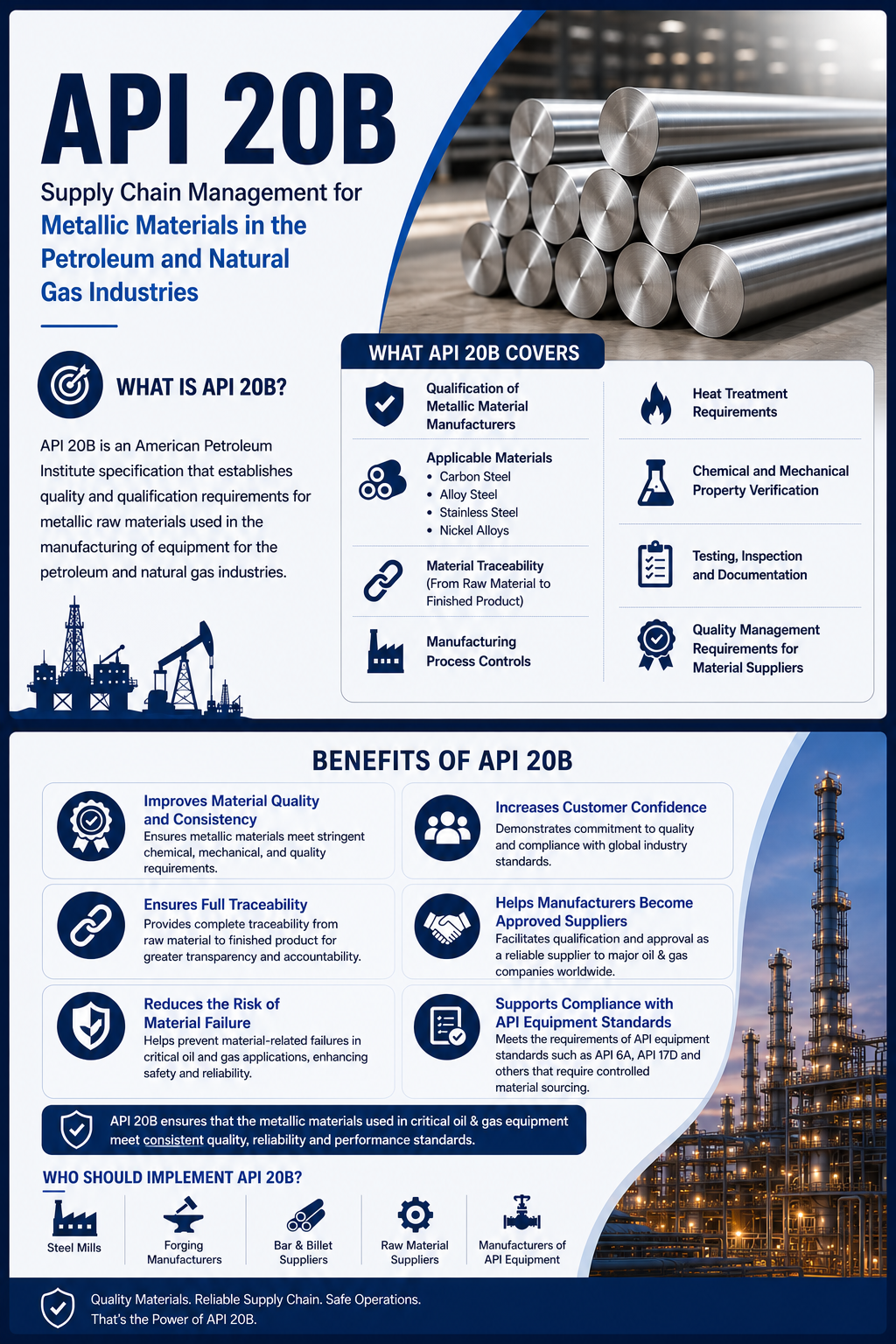
API 20B is an internationally recognized quality management specification developed by the American Petroleum Institute (API) for organizations that manufacture metallic materials used in the petroleum and natural gas industry. The standard establishes strict quality management requirements to ensure that forged products consistently meet customer, regulatory, and industry expectations.
For open forging manufacturers, API 20B demonstrates that the company follows controlled manufacturing processes, maintains complete material traceability, performs qualified inspections, and delivers products that comply with the demanding requirements of the oil and gas industry.
Unlike general quality certifications, API 20B focuses specifically on the manufacturing of metallic materials used in critical oilfield equipment where product reliability and safety are essential.
Why API 20B is Important for the Open Forging Industry
The oil and gas industry operates under extreme pressure, high temperatures, corrosive environments, and demanding service conditions. Components manufactured through open forging are commonly used in:
- Wellhead Equipment
- Christmas Trees
- Pressure Control Equipment
- Valves
- Flanges
- Drilling Equipment
- Pump Components
- Pressure Containing Parts
- Offshore Equipment
- Subsea Components
Because these applications are safety-critical, buyers require forged products manufactured under internationally accepted quality systems such as API 20B.
Holding an API 20B license increases customer confidence and improves opportunities to supply OEMs, EPC contractors, and global oilfield equipment manufacturers.
What Does API 20B Cover?
The scope of API 20B covers quality management requirements for manufacturers producing metallic materials intended for API equipment specifications.
The specification includes controls for:
- Open Forgings
- Closed Die Forgings
- Rolled Bars
- Hollow Bars
- Billets
- Blooms
- Ingots
- Cast Products (where applicable)
- Heat-Treated Materials
- Raw Material Processing
- Material Identification
- Manufacturing Controls
- Final Inspection
- Documentation
- Traceability
The objective is to ensure every forged product can be traced from raw material to final shipment.
Key Benefits of API 20B Certification
1. Global Market Acceptance
Many international oil and gas companies prefer suppliers certified under API 20B because it demonstrates compliance with recognized manufacturing standards.
2. Better Customer Confidence
Customers gain confidence knowing that every forging follows documented manufacturing procedures, inspection plans, and quality controls.
3. Complete Material Traceability
Every material heat, forging batch, heat treatment cycle, inspection report, and testing record can be traced throughout production.
4. Improved Manufacturing Control
The specification encourages manufacturers to establish standardized operating procedures, reducing process variation and improving product consistency.
5. Reduced Product Rejection
Controlled inspections and process monitoring help detect issues before shipment, reducing customer complaints and costly rework.
6. Stronger Export Opportunities
Many international buyers include API 20B as a supplier qualification requirement during vendor approval.
7. Competitive Advantage
Manufacturers holding API 20B certification often gain preference over competitors lacking internationally recognized quality systems.
Major Audit Parameters for API 20B Certification
Obtaining API 20B certification requires a comprehensive audit of both the quality management system and manufacturing operations.
The audit generally evaluates the following areas:
Quality Management System
The organization must maintain documented procedures covering every stage of manufacturing, inspection, testing, corrective action, and continual improvement.
Management Responsibility
Top management must demonstrate commitment through quality objectives, management reviews, resource allocation, and customer satisfaction monitoring.
Contract Review
Customer requirements must be reviewed before accepting orders to ensure manufacturing capability.
Material Procurement
Approved suppliers, material certificates, chemical composition verification, and receiving inspections must be documented.
Material Identification and Traceability
Every forging must remain traceable throughout manufacturing using unique identification systems.
Manufacturing Process Control
Forging operations must follow approved procedures covering:
- Heating
- Forging Temperature
- Reduction Ratio
- Cooling
- Heat Treatment
- Process Parameters
Equipment Calibration
Inspection and testing equipment must be calibrated according to defined schedules with traceable calibration records.
Personnel Competency
Employees performing quality-related activities must receive documented training and competency evaluations.
Heat Treatment Control
Heat treatment furnaces must be qualified and monitored with controlled temperatures, cycle records, and calibration documentation.
Inspection and Testing
Manufacturers must establish inspection procedures for:
- Visual Inspection
- Dimensional Inspection
- Mechanical Testing
- Chemical Analysis
- Non-Destructive Testing (where applicable)
Nonconformance Control
Nonconforming products must be identified, segregated, investigated, and dispositioned through documented procedures.
Corrective and Preventive Action
Root cause analysis and corrective actions must prevent recurring quality issues.
Internal Audits
Regular internal audits verify compliance with documented procedures and identify opportunities for improvement.
Document Control
Controlled documents must include revision history, approval records, distribution control, and document retention.
Record Retention
Manufacturers must retain production records, inspection reports, material certificates, calibration records, and audit documents for specified periods.
Documentation Required for API 20B
A manufacturer typically maintains documentation including:
- Quality Manual
- Quality Procedures
- Manufacturing Procedures
- Work Instructions
- Inspection & Test Plans (ITP)
- Material Traceability Records
- Mill Test Certificates
- Heat Treatment Records
- Calibration Certificates
- Internal Audit Reports
- Nonconformance Reports
- Corrective Action Reports
- Training Records
- Supplier Evaluation Records
- Customer Complaint Records
- Final Inspection Reports
How API 20B Benefits Open Forging Manufacturers
Open forging companies supplying the energy sector face increasing customer expectations regarding quality, traceability, and manufacturing consistency. API 20B helps establish standardized production practices that improve operational efficiency while meeting international customer requirements.
The specification encourages manufacturers to maintain documented forging parameters, controlled heat treatment processes, qualified inspections, and complete production records. As a result, companies can reduce production risks, strengthen quality assurance, and improve customer satisfaction.
For manufacturers seeking to expand into export markets, API 20B also supports vendor qualification by demonstrating a commitment to internationally recognized manufacturing and quality management practices.
Who Should Consider API 20B Certification?
This specification is suitable for:
- Open Forging Manufacturers
- Closed Die Forging Companies
- Steel Bar Manufacturers
- Hollow Bar Producers
- Billet Manufacturers
- Heavy Forging Companies
- Oilfield Equipment Suppliers
- Pressure Equipment Manufacturers
- OEM Component Suppliers
- Export-Oriented Forging Companies
Conclusion About API 20B
API 20B has become an important quality benchmark for manufacturers supplying metallic materials to the oil and gas industry. It provides a structured framework for quality management, process control, inspection, traceability, and documentation. For open forging manufacturers, certification can improve manufacturing consistency, strengthen customer confidence, and support access to global supply chains. By implementing the requirements of API 20B, companies can enhance product reliability, reduce quality risks, and position themselves as trusted suppliers in demanding industrial markets.
We are API Licensing Coordinator